About This Blog

Xenophon's Ghost covers military history and wargaming from the ancient period to modern times.

Monday, May 28, 2012

Hellenic Progress

I'm finishing up bases for additional Psiloi and two Artillery elements for my Hellenistic Morph collection. When complete, I will have enough elements to field two complete Hellenistic Armies from a list of 38 possibilities, including the Macedonians, Successors, and Hellenistic Greeks. I will use my Spartan Army initially for Hellenistic Greeks that require more than two Spear; I plan to paint up additional Hoplites later.


Greek and Roman Busts
Photo from my recent visit to the National Archaelogical Museum, Naples, Italy
I took inventory of completed or almost completed elements to help me decide what to paint next. My first goal is to expand my options for a single Army, rounding out the collection for the second Army later.  As of today, I have completed:
  • 12 Psiloi
  • 4 Auxilia
  • 2 Spear
  • 6 Pike
  • 2 Knight
  • 3 Cavalry
  • 2 Light Horse
With this set, I can field 12 different Book II Armies:
  • Alexandrian Macedonian (II/12)
  • Alketas (II/16c)
  • Pyrrhic (II/27a)
  • Eight Hellenistic Greeks (using Spartan elements at times) (II/31b,c,d,e, g,h,i,j)
  • Later Macedonians (II/35b)
I have two Elephants cleaned up, but I am waiting for an order of "Green Stuff" modeling putty to arrive.  The Essex-brand Elephants are made in three pieces, so I need the putty to fill in the seams.
Once the Elephants are ready, I will be able to field 13 additional Armies.

In the meantime, I will paint up additional Auxilia.  Four more Auxilia bases will yield four more Armies, a good return on investment!

When I posted photos of the Hellenistic elements recently, the posting resulted in a fruitful discussion in the Yahoo DBA Group on washes.  I only used a light ink wash; many viewers recommended a darker wash to bring out a better contrast.  I experimented with different washe techniques on eight Psiloi elements.  I'll posted comparative photos in a future post, once the basing work is completed.

Sunday, May 13, 2012

Pikes Poking Warbands

Ryan and I played a game of DBA today, using the draft 3.0 rules.  We pitted Alexandrian Macedonians, using half-finished Artillery as one element, against Galatians (II/30b).  Ryan played the Galatians, selecting a Warband element as his General.  Both Armies have an Aggression factor of 4.  The dice broke in Ryan's favor, so I was the defender.  


Galatian camp behind hill
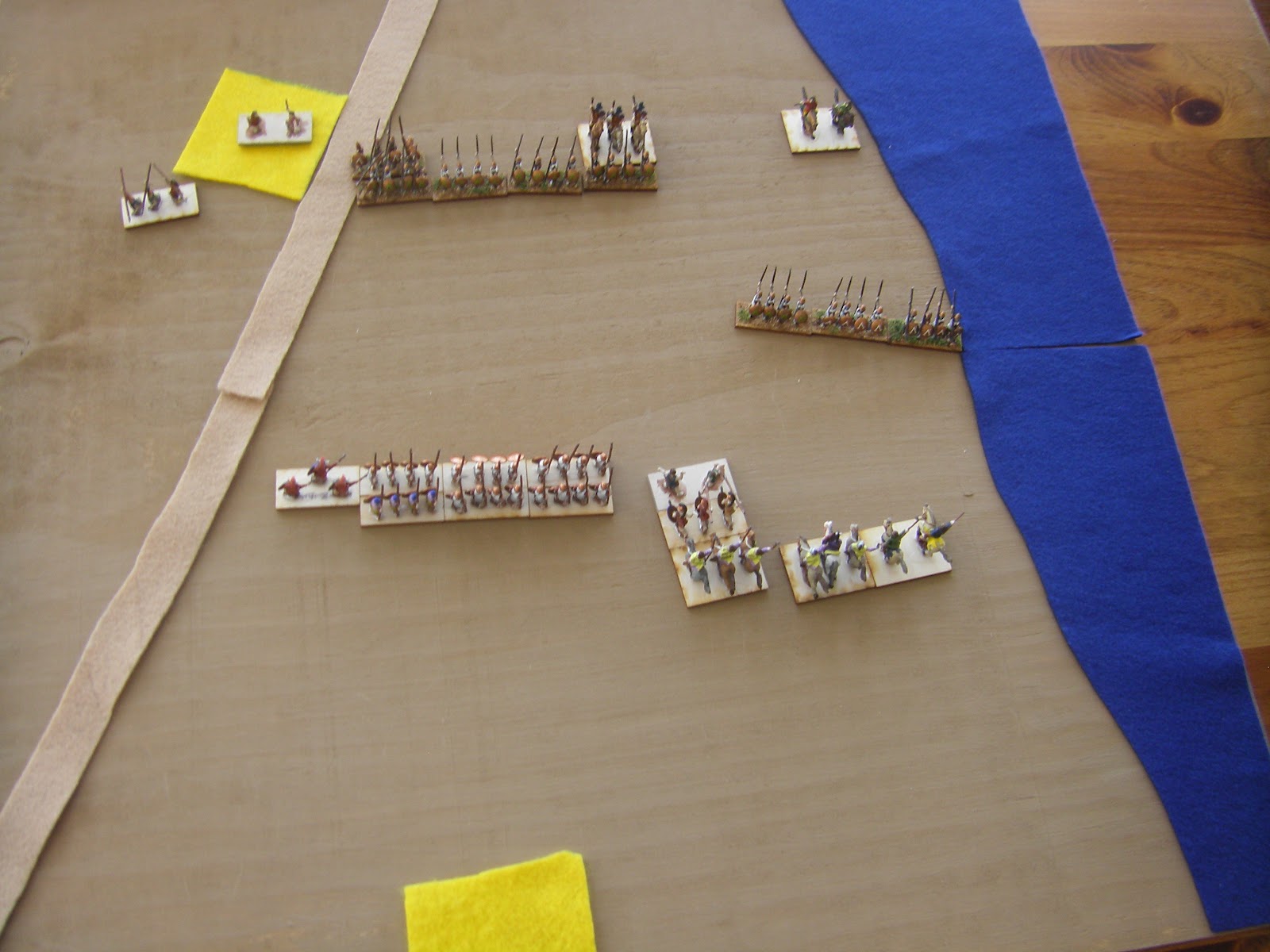
I deployed the Phalangites (Pk), General (Kn), and Thessalian Cavalry (Cv) on my left wing, covering the other side of the board with Light Horse, Artillery, and two light infantry elements in the woods (Ax and Ps).  Ryan  deployed two groups of Warband, one in reserve, to face off with the Pikes.  He placed his Cavalry on the right, and used a Psiloi element to protect his camp, which was located behind a hill.


I advanced my main force and Light Horse during the first bound. My artillery firing forced a Cavalry unit to recoil.
 Situation after the defender's first bound


The Galatians advanced, and the two main forces battled it out over three turns.  Ryan spent some PIPs trying to move his Cavalry into position to attack the artillery and deal with the Light Horse.  I moved Peltasts (Ax) to the side of the Artillery, to provide an overlap if needed. 

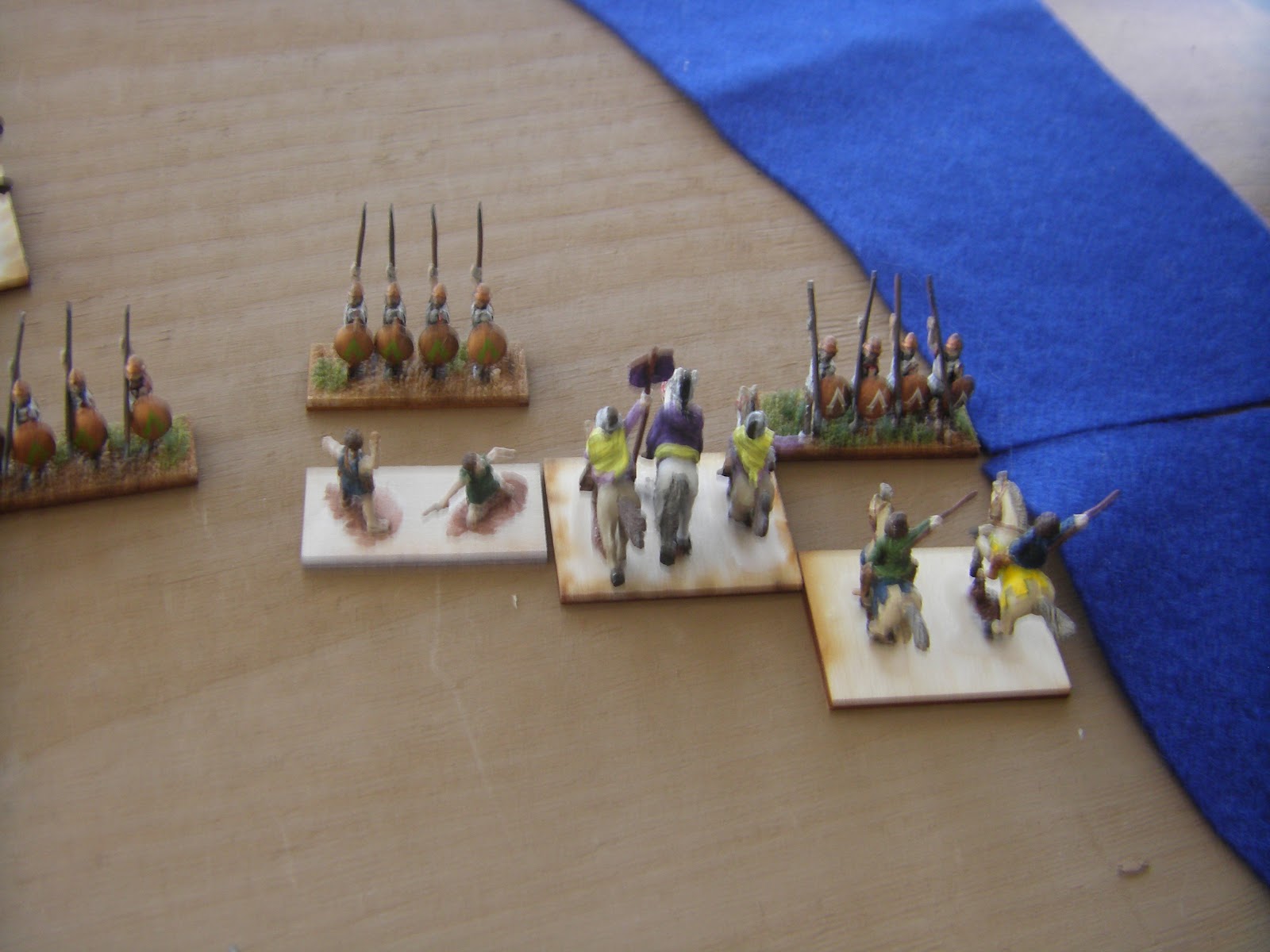
Galatian Cavalry prepare to charge Macedonian Artillery and Auxilia.

However, an artillery shot forced the Cavalry to recoil again. The game was over before the Cavalry made contact.  Thanks to the Pike rear support and overlaps, the Galatians lost three Warbands in bounds 3 and 4.  A fourth Warband was flanked by the Thessalian Cavalry in bound 5 and defeated.

It was a short game, but we both enjoyed it.  It had been awhile since we played. We used the new camps and partially finished camp dweller elements for the first time, too.

Friday, May 11, 2012

Upgrading from Felt Squares

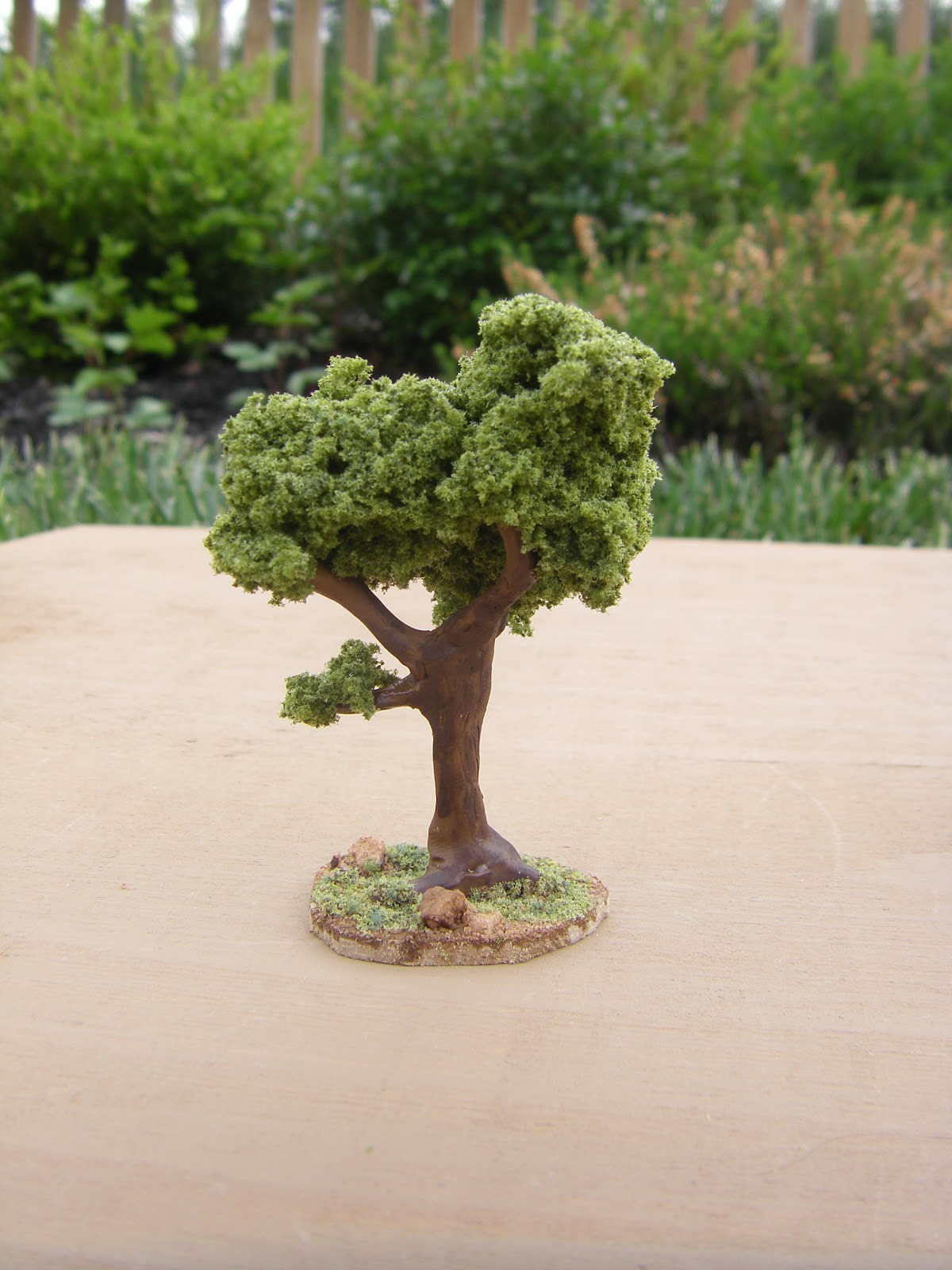
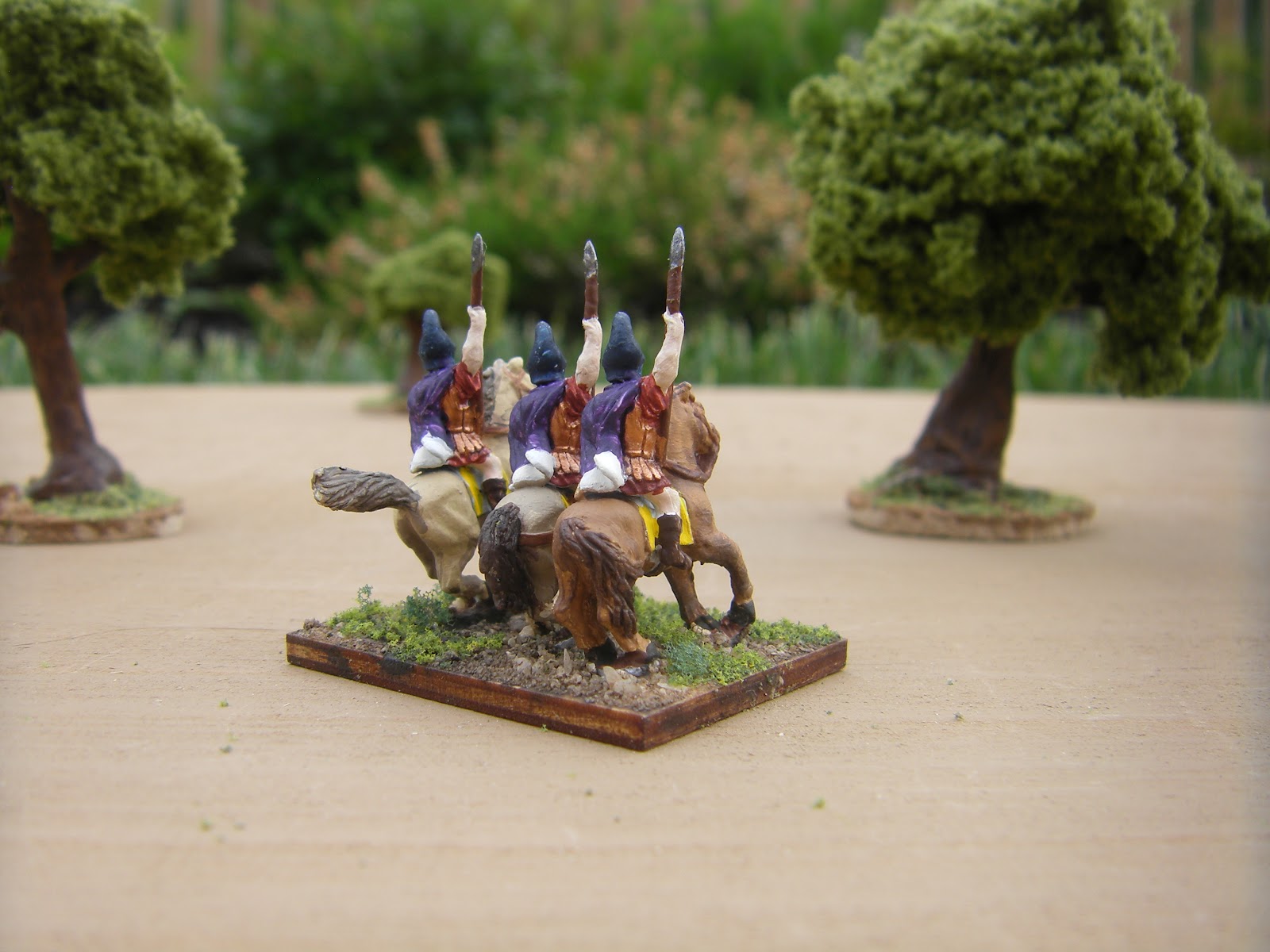
I have finally started working on terrain and camps for DBA.  When I first bought a few DBA armies, I expected to be 100 percent ready to play with terrain features much sooner.  However, my Hellenistic Morph project has consumed my time.  I used some of my daughter's "Sculpey" clay to create these trees and one of the camp features.

Clay Trees


In a model railroading project many years ago, I created trees using floral wire armatures covered in latex caulk.  I created armatures out of wire, covering it with Brown Sculpey clay.  After I was finished with this annoying step, my daughter pointed out that there was no need to use the wire.  Sculpey, once baked, is quite durable.


 I mounted the trees on masonite base material, painted with a variety of acrylic brown paints for shading, and used model landscape material for the foliage.  These trees are quite easy to make.

Camps

For my first two camps, I decided to go with some basic designs that would work for multiple armies, creating a tent scene and a rock wall.

The rock wall also involved Sculpey, gray clay this time around.  I created the wall out of the clay, glued it to the base, and pressed rocks into it before baking.  I finished up with a simple ink wash.


Here's a shot with a Spear element defending the camp.


The tent scene took a bit more work, but it was also an easy project.  I built the tent frame out of floral wire and super-glued canvas to it.  I coated the canvas in diluted white glue and painted the tent a gray color.


Peltasts (Aux) are defending the camp.


I've also made some "rough" terrain pieces and hills, so I will be able to upgrade from the felt squares look soon.

Regards from Maryland,
Dave

Wednesday, May 9, 2012

Cavalry Gallery

Yesterday, I showed off my completed Macedonian foot elements.  Let's look at the Cavalry and Knight elements.

It would be fitting to start with Alexander the Great himself.  I'll use this element as a 3Kn General.  I preview of the DBA 3.0 draft Army lists show that the Knight elements will be 3Kn, meaning that 3 figures are used.  I had already purchased my figures before seeing the draft list, so I did create one 4 Kn element.  Unless the rules change, I should be able to use elements with either 3 or 4 figures.


The 4KN element used Essex Super Heavy Cavalry figures.  It was a tight squeeze to get four on the base.


I handpainted the Macedonian stars on the mounted element shields.


These two Cavalry elements include another General element.  The majority of Hellenistic armies use Cavalry or Knight Generals.


I made one Thessalian cavalry element, painting their cloaks a dark blue with a white band at the bottom. 


Finally, I need some Light Horse - Hippokontistai, so two elements round out the first batch of figures for the Morph collection.


Lessons Learned


Painting

I tried several new painting techniques this time, to include ink washes (covered in an earlier post), shading on horses, and more practice using white primer, instead of black.   I have also continued to differentiate my armies in the basing, using a different paint color and ground cover.

References

A major difference in Ancients figures and more modern eras (such as AWI and Napoleonics) is the lack of primary references on uniform color.  I used Osprey Publishing's "Alexander the Great at War - His Army - His Battle - His Enemies" as the main reference for my painting work.  While this book is comprehensive and appears well researched, there is generally much speculation on the color of clothing and equipment for this period.  I had the opportunity to visit Pompeii in March, and the Mosaic depicting Alexander and Darius is a key source for the period.  However, even this Mosaic was designed many years after the battle -by Romans, or possibly a Greek artist in the employ of Romans. Who is to know the accuracy of the depiction?

I frankly find the ambiguity liberating.  Rather than obsessing over the color of a collar, the Ancients gamers can aim to get the general concept right and not quibble on the minor details.

Pacing

My only regret in this effort was biting off so many different figures all at once.  It was a challenge to stay on track.  I'll work on a smaller number of homogenous figures in the future when I can, so I can achieve some tangible progress quickly.   I recently knocked out the remainder of my Psiloi figures and artillery figures in a week because the project wasn't overwhelming.

Aloha from Waikiki,
Dave


Tuesday, May 8, 2012

Macedonian Gallery

I finished my first batch of 15mm Macedonian/Hellenistic Greek figures for my Hellenestic Morph collection.  The Morph collection, when completed, will allow me to field two Hellenistic DBA armies, ranging from the Alexandrian armies to all of the Successor States.  I will also be able to use elements from my Spartan army to field a few of the Hellenistic Greek armies.

All of the figures are Essex brand.

Let's look at the infantry.


I painted six Pike elements, if I recall these are called "Western Macedonian" pikes by Essex.  I used transfer decals for the Macedonian stars on the shields.  One element was painted as Foot Companions.  The others were painted with red tunics and white linothorax.  If I field an Army with a General Pike element, the foot companions will be a distinctive General element.


For Auxilia, I painted two elements of Peltasts (above) and two elements of Illyrian Javelin (below).


I bought a bunch of Greek slingers for Psiloi, painting up four elements in this first batch. A few Successor States and Hellenistic Greek armies field many Psiloi, I have more to paint, including Scythian slingers for variety.


Finally, Greek mercenaries played a role in many Successor State battles, so I have painted up two elements.  The shields are handpainted.


Tomorrow, I'll post photos of the mounted elements - Cavalry and Knights - and share a few lessons learned from this painting effort.


Saturday, March 10, 2012

BUA Test Run 1

I'm on the road for work, so this is my first posting attempt using an iPad. I'll keep the prose shorter than normal! In order to learn the BUA rules, we played Alexandrian Macedonians against Later Hoplite Thessalians. We combined elements from my Macedonian Morph army and Spartans to form the forces.

The Thessallians defended, using a Built-Up Area (BUA) instead of a camp. The Macedonian attackers deployed near the BUA, placing three elements in contact with the BUA. (I welcome feedback on this deployment. I did not find a rule precluding contact with the BUA from the onset of the game.) The Thessalians used a spear element to defend the area.

The dice clearly favored the Thessalians throughout the game. The Greeks rolled 6 PIPs and advanced, moving several mounted units along its right flank to relieve the BUA. In the first round of close combat, the Macedonians attacked the BUA to no good effect. Two elements recoiled. One Spear remained in contact due to a tie.

In the second round, Thessalians again rolled 6 PIPs and moved elements forward. The Macedonians rolled a one, moving the Knight General back in contact with the BUA. The attacking Spear lost and recoiled. Disaster soon struck. The General rolled a 1, adding 4. The defending Spear rolled a 3, adding 8 and killing the General. This was a tough lesson to learn...be careful of risking a General against a defended BUA...The assault was abandoned.

General melee followed, with the Pikes and Spears clashing. A Thessalian LH supported the Spear, flanking the Pike formation and destroying the front rank. This caused a bit of a rules scramble to confirm that the rear support was not destroyed in DBA 3.0: it is not.

Because of the flank contact, the Pike that had provided rear support turned to face the Light Horse in the next bound. (I welcome feedback whether this was the correct move to make.)

The Macedonian Pike destroyed one Spear in the line.

The game ended in the next bound when light troops on the flank engaged. A Thessalian auxilia rolled a 6 (+2), destroying a Cav unit that rolled a 1 (+3).

This was a fun bout. I plan to try out BUA battles again with the latest version of the draft rules.

Monday, February 20, 2012

Macedonians Face Athenians

Macedonian Peltasts and Phalangites prepare to advance 
Ryan and I playtested the DBA 3.0 rules, using my newly painted Macedonians.  The paint is dry, but the bases are not finished.  By combining elements with my Spartan army, we were able to field Alexandrian Macedonians (II/12) and Athenian Hoplites (II/5b) in the first game.  We wanted to learn the BUA and littoral landing rules.  Since these were test games, Ryan played defender so we could use a waterway, and we decided to place the BUA on his side of the board.  As a result, the BUA never came into play.

Initial deployment with three Athenian spears in reserve
Ryan deployed a Psiloi in the BUA and held three Athenian spear in reserve for a littoral landing.  He placed Light Horse and Auxilia on the right and left flanks respectively.  The rest of his spear line and a troop of Thessalian cavalry formed the main force.

I deployed the Macedonian Pikes in a two deep formation, flanked by the Knight General and Auxilia.  Expecting Ryan to land deep into my area,  I placed light troops and cavalry on the right to cover the flank.

On the first bound, Ryan rolled a "1", so he could only land his spear.  He played it conservatively.   The flank side of one element of the group is in contact with the waterway per the rules.


Rolling a five on the first bound, the Macedonians advanced forward.  I shifted the Knight General to the right and formed it into a group with the Light Horse, planning to attack the three Spear forward.


In the second bound, the first combat occurred when the Macedonian Knight and LH advanced, joined by a Psiloi.  I would have preferred to use a stronger element than the Psiloi, but the force positions wouldn't allow it.  Ryan continued to advance his main Spear line, aiming to reinforce the landing party.
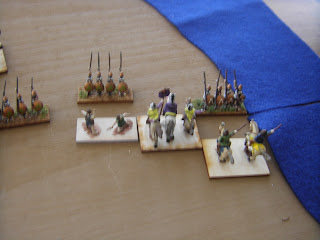


The Knight General prevailed, quick killing the middle spear.  However, the other two melees resulted in recoils.  With other Spear to the right of the Psiloi, I started worrying that my General might end up in trouble.
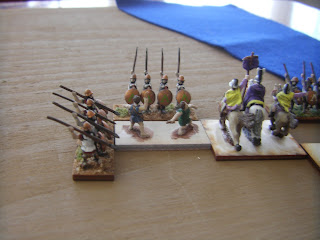

Ryan flanked the Psiloi and used other PIPs to begin moving his mounted forces to the left, intending to flank the main Pike phalanx.

The Psiloi was destroyed in this matchup.


To prevent a flanking of my General, I moved an Auxilia forward in my next bound. The Spear turned and faced it.  The dice favored the Athenians, and the Auxilia were destroyed. 


The game culminated in a flanking of a Spear and the main phalanx engaging. 

The Knight General  and the Companion Cavalry engaged a spear element, with the Spear turning to face the Knight.  The Macedonians won this match-up, making the game tied at 2-2.

Pikes with rear support are very strong.  While the first Pike-Spear melee resulted in the Athenians recoiling, the Macedonians won the next two melee, ending the game.


After Action Review

We intended to use this game to learn the BUA rules, but we never got that far.  This was our first game played with Pike miniatures.  When we first tried out DBA, we fought a few games with paper armies that included the Imperial Macedonians using DBA version 2.2.  I must say that Pikes are impressive.  Ryan and I discussed what type of tactics you would need to use in a Pike -Spear match-up like this.  Duking it out with the main force wasn't a good plan for the Athenians.  Between the Pikes and the Knight General element, the Macedonians are very strong against a spear-heavy foe.

The littoral landing rule works fine, and it adds interest to the game.  If Ryan had more PIPs in the first bound, I suspect that he would have been more aggressive.  He never got his cavalry or light horse engaged in the game which could have made a difference.  Similarly, a Psiloi and Auxilia element were deployed primarily to protect the BUA, so the Athenian's fighting force was weakened.

 We tested out the BUA rules in a second game - Alexandrian Macedonians vs. Thessalian Hoplites (II/5d) which I'll describe in my next post.  We had so many questions about the BUA rules that we ended the game early...